Most hospitals have a vague sense that wheelchairs cost them money. A few go missing each month. Staff spend time looking for them. Replacements get ordered. The procurement team sighs. And then everyone moves on — because there are bigger things to worry about.
That resigned acceptance is expensive. The real cost of poor wheelchair management isn’t just the price of a replacement chair. It runs through porter productivity, patient throughput, discharge delays, and nurse time that should be spent on clinical care. None of it shows up on a single line item. That’s precisely why it never gets fixed.
The Number That Gets Everyone’s Attention
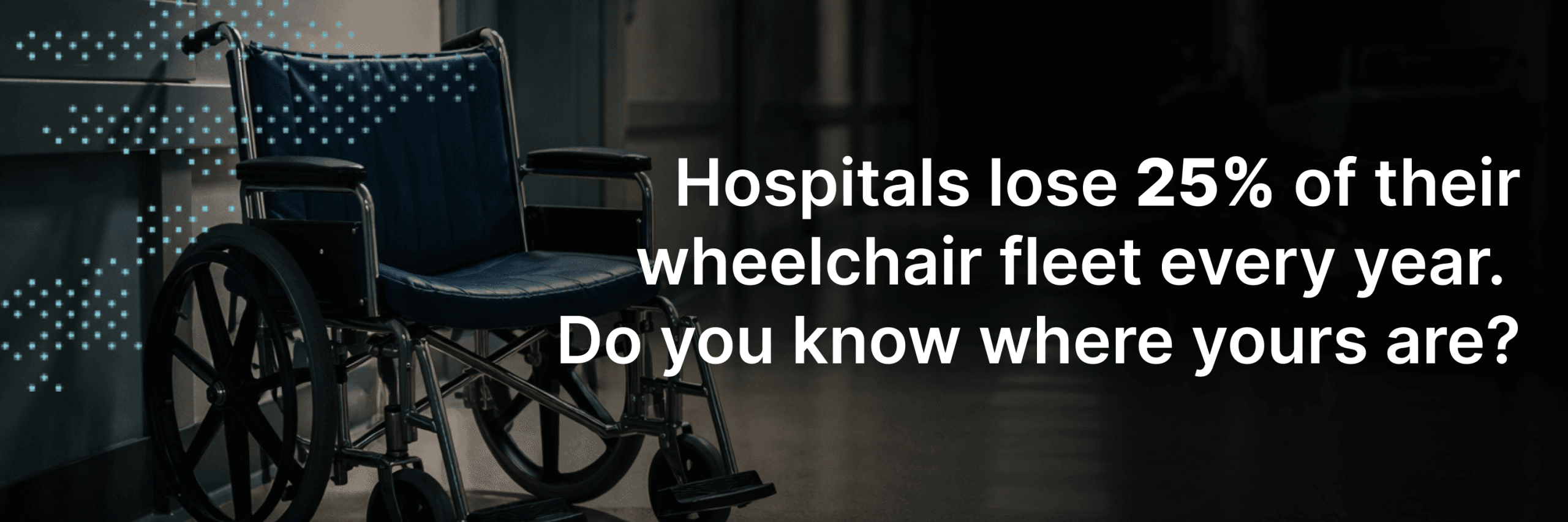
Industry data consistently shows that hospitals lose between 10% and 25% of their wheelchair fleet every year to theft, misplacement, and attrition. For a mid-sized hospital operating a fleet of 200 chairs, that’s 20 to 50 units disappearing annually.
At $500–$700 per replacement unit, a 200-chair fleet losing 25% annually costs $25,000–$35,000 in hardware alone — before a single operational minute is counted.
That figure is uncomfortable but manageable. What makes it a serious business problem is everything that surrounds it.
The Five Hidden Costs Nobody Adds Up
Procurement cost is the number that gets budgeted. These five are the ones that get absorbed.
Staff search time. Research suggests nurses and porters spend up to 20 minutes per shift searching for available wheelchairs. In a busy hospital running multiple shifts across multiple wards, that accumulates fast. Across a 500-bed facility, this can represent thousands of hours of staff time annually — time that is being paid for, but not spent on patients.
Porter bottlenecks. When a porter is dispatched to move a patient and can’t find a wheelchair at the expected location, they return to the dispatch desk, wait, or improvise. Each breakdown in the chain adds minutes to a patient transport request. Multiply that across a hospital’s daily transport volume and you have a systemic throughput problem disguised as a minor inconvenience.
Discharge delays. Discharge is one of the highest-pressure moments in hospital operations. A patient is medically cleared, a bed is needed, and the process depends on getting the patient from ward to exit efficiently. A missing wheelchair at this stage doesn’t just inconvenience one patient — it blocks a bed, delays the next admission, and puts pressure on an already strained system.
Over-procurement. Without visibility into utilisation, most hospitals respond to shortages by buying more. Some of those shortages are real. Many are not — the wheelchairs exist, they’re just in the wrong place. Purchasing to compensate for invisible inefficiency is one of the most avoidable costs in hospital asset management.
Patient satisfaction. A patient who waits 30 minutes for a wheelchair at discharge doesn’t think ‘the hospital has a visibility problem.’ They think ‘this hospital is disorganised.’ Patient experience scores are increasingly tied to operational performance. Wheelchair availability is a small but tangible signal that shapes how patients perceive an entire episode of care.
Why the Problem Persists
The honest answer is visibility — or the lack of it. Wheelchair management in most hospitals is handled manually: periodic physical counts, department-level responsibility, and ad hoc responses to complaints. The data that would allow a systematic fix simply doesn’t exist in a useful form.
Managers know the problem is there. They can see it in the complaints, in the porter wait times, in the procurement requests. What they can’t see is where every wheelchair is right now, how many are actually in use versus abandoned in a corridor, and where the recurring misplacement patterns are.

Without location data, every response to a wheelchair shortage is reactive. The problem gets solved for today, and recreated tomorrow.
This is the gap that real-time asset tracking closes. Not by adding more hardware to the problem, but by creating the operational visibility that allows the root cause to be addressed rather than worked around.
What Operational Visibility Changes
Hospitals that have implemented BLE-based wheelchair tracking report annual savings of up to $75,000 through reduced loss and optimised fleet usage. But the more meaningful shift is operational: when staff can locate a wheelchair in under a minute rather than spending 20 minutes searching, the entire flow of patient movement becomes more predictable.
Porters can be dispatched with confidence. Discharge coordinators can plan with accurate asset availability. Procurement decisions are based on real utilisation data, not guesswork. And the quiet accumulation of small inefficiencies — the ones that never make it onto a board report — stops compounding.
The technology itself is straightforward. BLE tags attached to each chair communicate with receivers positioned across the facility, surfacing real-time location and utilisation data in a centralised dashboard. Alerts can be configured to flag when a wheelchair exits the building, when fleet levels in a department drop below a threshold, or when a chair has been stationary in an unexpected location for an extended period.
The infrastructure requirement is minimal. Most hospitals already have the network foundation to support a system like this. The barrier isn’t technology — it’s the decision to treat wheelchair management as an operational discipline rather than an administrative inevitability.
Making the Internal Case
If you’re building a business case for wheelchair tracking internally, the numbers are straightforward. Start with your current fleet size, your estimated annual loss rate, and the unit replacement cost. Add a conservative estimate of daily staff search time — even 10 minutes per shift, per ward — and convert it to an annual labour cost. Then model what a 50% reduction in both figures would look like.
For most hospitals, the payback period on a BLE tracking system is under 18 months. The harder argument isn’t financial — it’s organisational. Wheelchair tracking requires someone to own the data, act on the alerts, and close the loop when patterns emerge. That operational commitment is what separates a tracking system that sits unused from one that delivers sustained improvement.
The wheelchairs aren’t the problem. The absence of accountability and visibility around them is.
Dex deploys BLE-based asset tracking across hospital environments, with real-time dashboards built for operations teams rather than IT departments. If wheelchair management is one of several non-clinical efficiency gaps you’re trying to close, explore how Dex approaches hospital asset management — or get in touch to discuss your specific environment.
About the Author
Satayender Chaudhary is the Founder and CEO of Dex — an AI and IoT-powered SaaS platform that helps hospitals, facility management companies, smart buildings, and manufacturers move from reactive operations to real-time, data-driven decision-making.
He has spent years working at the intersection of indoor location intelligence, IoT infrastructure, and operational analytics, helping organisations in healthcare, commercial real estate, and manufacturing solve the visibility and efficiency challenges that legacy systems leave behind.